The Death of Unclaimed Time
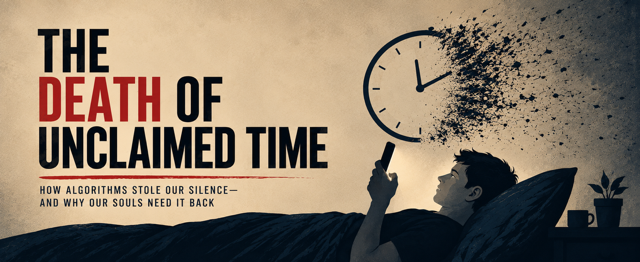
I recently came to a stop at a red light and automatically reached for my phone. I’m pretty sure I do it all the time. It has become a reflex. I know I’m not the only one who suffers from this compulsion. Look around the next time you stop at a traffic light.
Red light? Phone. Waiting room? Phone. Sitting alone before someone arrives? Phone. Commercial break? Phone. Bathroom? Definitely phone. We hardly experience an unoccupied moment anymore.
There was once such a thing as “unclaimed time.” Time to do nothing. It created margin in our lives, allowing our hearts and minds to rest. Algorithms are designed to solve problems or optimize outcomes. I didn’t realize unclaimed time was a problem to be solved. However, algorithms have “fixed” a problem that wasn’t a problem at all.
Algorithms aren’t inherently bad. They’re simply very good at what they’re designed to do: capture and hold our attention.
We need a resurrection of unclaimed time. We need to be able to sit for an hour or two with nothing but our own thoughts.
There are real benefits to having periods when we aren’t consuming anything—no phones, podcasts, music, television, or scrolling. Sitting with our own thoughts creates the kind of unclaimed time our hearts and minds desperately need.
It helps our minds process life. Quiet gives our brains room to reflect on experiences, emotions, conversations, disappointments, and decisions rather than constantly replacing them with new input.
It encourages creativity. When our attention isn’t occupied, our minds wander and make connections between ideas that we might otherwise miss. Boredom can actually become fertile ground for imagination.
It strengthens self-awareness. Silence allows us to notice what we’re thinking, wanting, fearing, and feeling. Constant stimulation can keep us distracted from what is actually happening inside us.
It restores our attention. Doomscrolling trains us to expect novelty every few seconds. Unstimulated time exercises our ability to remain present without needing another hit of information.
It creates space for deeper thinking. Algorithms continually decide what deserves our attention next. Unclaimed time allows us to decide what deserves our attention.
It can create space for prayer and contemplation. From a Christian perspective, silence isn’t necessarily emptiness. It can become attentiveness to God: “Be still, and know that I am God” (Ps. 46:10).
It teaches us that boredom isn’t an emergency. We don’t have to fill every line, waiting room, red light, walk, or quiet evening with content.
We have confused boredom with a problem. We have begun treating it almost like a discomfort that requires immediate relief. But boredom can be the doorway to deeper thought. For generations, the empty spaces of life gave us time to think, imagine, pray, notice, remember, and wonder.
Now, the moment boredom arrives, we reach for a screen. The algorithm offers to fill every empty space—and we gladly hand it our attention. Perhaps what we call boredom was never wasted time. Perhaps it was where some of our most important thinking happened.
Scripture repeatedly calls God’s people to stillness, meditation, solitude, prayer, Sabbath, and attentiveness. Jesus Himself regularly withdrew from crowds and activity to solitary places to pray.
Maybe the greatest spiritual danger of our phones isn’t simply the content they show us. Maybe it’s that they have made it increasingly difficult for us to be still long enough to examine our hearts and attend to God.
Not every empty space needs to be filled. Not every quiet moment needs a soundtrack. Not every second of boredom needs to be cured. Some time should remain unclaimed. Because it may be in those seemingly empty spaces that we finally find enough silence to hear our own hearts—and perhaps even hear from God.